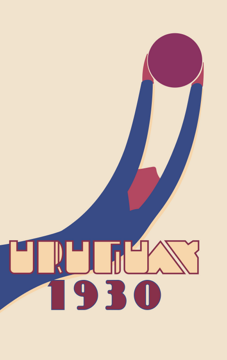
1930
Uruguay '30
1934
Italy '34
1938
France '38
1950
Brazil '50
1954
Switzerland '54
1958
Sweden '58
1962
Chile '62
1966
England '66
1970
Mexico '70
1974
West Germany '74
1978
Argentina '78
1982
Spain '82
1986
Mexico '86
1990
Italy '90
1994
United States '94
1998
France '98
2002
Korea Japan '02
2006
Germany '06
2010
South Africa '10
2014
Brazil '14
2018
Russia '18
2022
Qatar '22
2026
USA Canada Mexico '26
2026
USA · Canada · México · 2026
FIFA World Cup
11 Jun – 19 Jul 2026 104 matches USA Canada Mexico '26
👟︎ Golden Boot
Kylian Mbappe
FRA France
⚽︎ Golden Ball
Rodri
ESP Spain
🧤︎ Golden Glove
Unai Simón
ESP Spain
⭐︎ Best Young Player
Pau Cubarsí
ESP Spain
ESP Champion

Spain win by refusing to concede anything

The Campaign

Luis de la Fuente's Spain opened with a 0-0 draw against Cape Verde in Atlanta and were written off as laboured. Then they stopped conceding. Saudi Arabia were beaten 4-0 Lamine Yamal's first World Cup goal and Uruguay 1-0 to win Group H. Austria fell 3-0, Portugal 1-0, Belgium 2-1, and France 2-0 in the semi-final through Mikel Oyarzabal and Pedro Porro. Across eight matches they conceded a single goal the first champion in the tournament's history to do so. Rodri captained and controlled it; Unai Simón barely had to be brilliant because the ball so rarely arrived.

The Final

At MetLife Stadium, in front of 80,663, Argentina did not register a shot in ninety minutes a first for a World Cup final. Spain kept the ball and kept asking; Emiliano Martínez answered 11 times, a record for a final. Enzo Fernández was sent off in the 93rd minute for a second yellow on Pau Cubarsí, and in extra time the dam broke: Nico Williams' header dropped to Ferran Torres, who finished it in the 106th minute. 1-0. Sixteen years after Johannesburg, Spain had a second star and became the first nation ever to hold the men's and women's World Cups at the same time.

1-0 final (aet)Ferran Torres 106'One goal conceded in eight
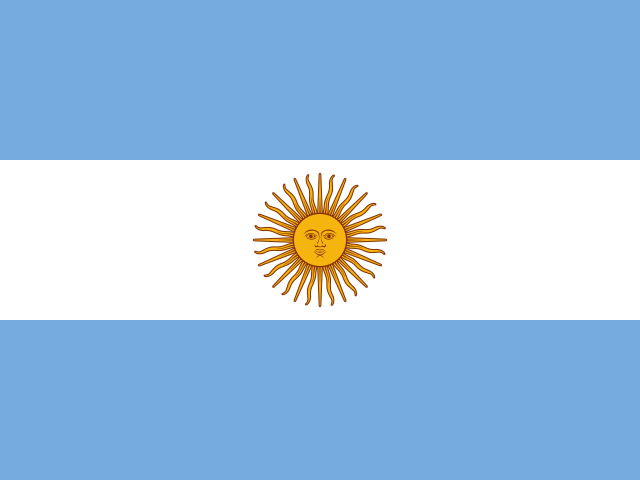
ARG Runner-up

Argentina run out of road, and Messi out of time

The Journey

Argentina defended the title the hard way. They swept Group J past Algeria, Austria, and Jordan and against Austria Lionel Messi scored the goal that took him past Miroslav Klose as the World Cup's leading scorer, two days before his 39th birthday. Then came the gauntlet the 48-team format built: Cape Verde 3-2 in extra time, Egypt 3-2, Switzerland 3-1 in extra time again, and England in the Atlanta semi-final, where Lautaro Martínez finished a Messi pass to complete a late comeback. Eight goals from Messi, four knockout rounds, two of them beyond ninety minutes. They arrived at the final with nothing left.

The Heartbreak

Spain took the ball and never gave it back. Argentina managed no shot at all in regulation no World Cup finalist had ever done that. Emiliano Martínez was magnificent in defeat, making a record 11 saves, but Enzo Fernández's dismissal in the 93rd minute left ten men to survive extra time and they could not. Ferran Torres scored in the 106th minute. Messi walked off a World Cup pitch for the last time as a runner-up and no longer even the competition's leading scorer, Mbappé's ten goals having overhauled him before France's tournament was out. The trophy he had finally won in Qatar was handed on after four years.

1-0 defeat (aet)Messi passes KloseNo shot in 90 minutes
Top Scorers
1 FRA Kylian Mbappe 10
2 ARG Lionel Messi 8
3 ENG Jude Bellingham 7
3 NOR Erling Haaland 7
5 ENG Harry Kane 6
5 FRA Ousmane Dembele 6
Golden Boot
Kylian Mbappe

Mbappé's ten goals won a second consecutive Golden Boot no man had ever retained it and carried him past every scorer in the competition's history. Messi scored eight on the way to the final, overtaking Klose before Mbappé overtook him. Lautaro Martínez and Ferran Torres scored the goals that decided a semi-final and a final. Across 104 matches the tournament produced 308 goals, 2.96 per game the highest rate since 1970 and the third-place match alone contributed ten of them.

The World in 2026

The biggest World Cup ever attempted

Football

The first 48-team World Cup, the largest expansion in the tournament's history: 104 matches over 39 days, 308 goals, and 6.8 million people through the turnstiles a new attendance record, beating the mark the United States set in 1994. Estadio Azteca hosted World Cup matches for a third time, the only venue ever to do so. Messi and Ronaldo both reached a record sixth finals. And the format's great fear that more teams would mean weaker football went unrealised: 2.96 goals a game was the highest rate since 1970.

The World

Three nations co-hosted across 16 cities and six time zones. AI was transforming daily life. Climate anxiety shaped public discourse. The world was more multipolar than at any point since the Cold War. The question had stopped being who plays and become how many stories one tournament could hold and the answer, in the end, was a champion that conceded once, a 39-year-old who became the competition's leading scorer and then lost it to the man who beat him to the Golden Boot.

48 teams308 goals6.8M attendance record
The Venues

Continent-scale hosting

Preparation

No new stadiums were built. The 48-team format used existing NFL, MLS, and Liga MX venues across three countries sixteen stadiums in sixteen cities, from Vancouver to Guadalajara, from Seattle to Miami. Natural grass was laid over artificial surfaces in several NFL venues.

The Venues

MetLife Stadium in New Jersey hosted the final, 80,663 through the gates for Spain and Argentina. SoFi Stadium in Los Angeles, AT&T Stadium in Dallas, and the Estadio Azteca in Mexico City were among the marquee venues. The Azteca became the first ground in history to host World Cup matches at three separate tournaments. The geographic spread was the largest ever, spanning six time zones, and the tournament drew a record 6.8 million spectators in total.

16 stadiumsMetLife finalAzteca's 3rd World Cup
USA Canada  Mexico 2026
USA Canada Mexico 2026
0 matches

Played across 48 teams

72Group16R328R164QF2SF13rd1Final

The Host Cities

Sixteen cities across three nations

The Cities

Vancouver, Seattle, San Francisco, Los Angeles, Guadalajara, Mexico City, Monterrey, Dallas, Houston, Kansas City, Atlanta, Miami, Toronto, Boston, Philadelphia, and New York/New Jersey hosted matches across three countries and six time zones. The distances were the greatest in World Cup history. Teams were based at professional club training centres and university campuses, and the climates ran from Pacific Northwest rain to Texas heat.

Impact

The tri-nation hosting distributed economic impact across three economies. No new stadiums were built, which removed the risk of white-elephant venues existing NFL, MLS, and Liga MX infrastructure supplied proven large-capacity grounds. Host cities invested in transit, hospitality, and fan zones instead, and the tournament was projected to generate over $5 billion in combined economic activity. On attendance alone it worked: 6.8 million tickets used, a record. The model is now the obvious template for future multi-nation bids.

16 host cities3 nationsNo new stadiums
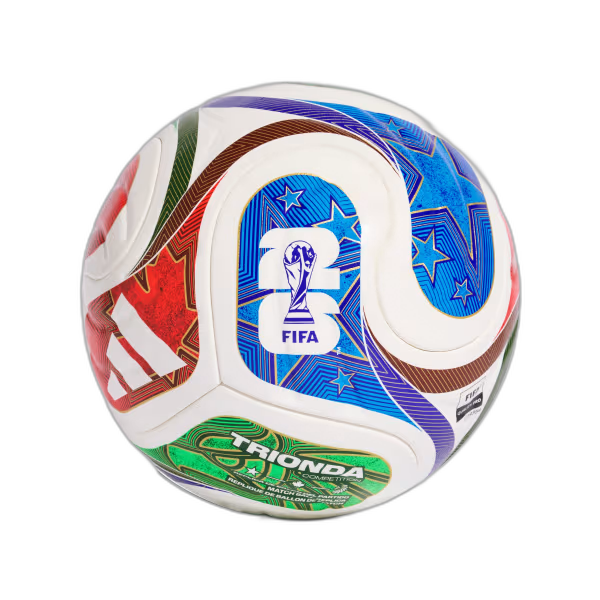
Adidas Trionda
On the pitch
0 goals

2.96per match

Match Ball
Adidas Trionda

Trionda 'three waves' in Spanish celebrates the first tri-nation World Cup. A brand-new four-panel construction, the fewest ever on a World Cup ball, uses intentionally deep seams for optimal in-flight stability and evenly distributed drag. Embossed micro-icons improve grip in wet and humid conditions across venues ranging from Mexico City's 2,240m altitude to coastal Miami. Red, green, and blue panels honour the three hosts, converging in a triangle at each panel's centre. A maple leaf, an eagle, and a star mark Canada, Mexico, and the USA. Inside, a 500Hz motion sensor feeds real-time positional data to VAR, enabling precise offside and handball decisions. CTR-CORE technology maximises rebound consistency across 90 minutes.

Goals by minute
37 1-15 32 16-30 43 31-45 58 46-60 46 61-75 92 76+
Goals by stage
Group215
R3242
R1623
QF12
SF5
3rd10
Final1
The Squads

Forty-eight teams, and the oldest answer won

The Contenders

The expanded 48-team field brought more nations than ever debutants from every confederation, Cape Verde taking a point off the eventual champions and then a place in the last 32. Argentina defended the title to within fourteen minutes of a shootout, Messi and Ronaldo both reaching a sixth finals. But the wider field did not produce the first-time winner it promised. England reached a semi-final and then the strangest third-place match ever played, a 6-4 win over France. The two teams that met in the final were a past champion and a past champion.

Style & Identity

The tri-nation hosting across the USA, Mexico, and Canada made this the most geographically sprawling tournament in history six time zones, punishing travel, and altitude from sea level to 2,240m. 12 groups of four meant more matches and fewer dead rubbers, and the knockout rounds that followed were long enough to grind squads down: Argentina went to extra time twice before the final and had nothing left when they got there. Spain's answer to a sprawling tournament was to shorten it keep the ball, concede once in eight games, and let everyone else do the running.

48-team debutEngland 6-4 France for 3rdA past champion won
Golden Ball
Rodri
Spain

A Golden Ball won without a highlight reel. Rodri captained Spain and set the tempo of eight matches in which they conceded once the deepest a holding midfielder's influence has ever been read by the voters. He did not score in the knockouts. He did not need to: the tournament's best team was built around him keeping the ball away from everyone else.

Golden Glove
Unai Simón
Spain

Won the Golden Glove behind the meanest defence a World Cup has ever crowned Spain conceded one goal in eight matches, Belgium's consolation in the quarter-final the only blemish and kept the final itself clean. The opposite of Martínez's theatre in 2022: a tournament spent making the hard thing look uneventful.

Golden Ball
Rodri
Spain

A Golden Ball won without a highlight reel. Rodri captained Spain and set the tempo of eight matches in which they conceded once the deepest a holding midfielder's influence has ever been read by the voters. He did not score in the knockouts. He did not need to: the tournament's best team was built around him keeping the ball away from everyone else.

Golden Glove
Unai Simón
Spain

Won the Golden Glove behind the meanest defence a World Cup has ever crowned Spain conceded one goal in eight matches, Belgium's consolation in the quarter-final the only blemish and kept the final itself clean. The opposite of Martínez's theatre in 2022: a tournament spent making the hard thing look uneventful.

The Legends

Messi's last record, Mbappé's bigger one

Stars

Lionel Messi played his sixth and final World Cup and left it holding, briefly, the record that mattered most: his goal against Austria took him past Miroslav Klose, and he finished the tournament on eight. Then Kylian Mbappé scored ten a second consecutive Golden Boot, the first man ever to retain it, and the competition's all-time leading scorer at 27. Rodri took the Golden Ball without scoring a knockout goal. Lamine Yamal scored his first World Cup goal against Saudi Arabia; Pau Cubarsí, 19, was named best young player for defending.

Moments

The opening match in Mexico City brought Estadio Azteca back to the World Cup stage for a record third edition. Sixteen cities across three nations staged 104 matches over 39 days. Cape Verde, at their first finals, drew with the team that would win it. England and France produced a 6-4 third-place match in Miami. And at MetLife, a final in which the defending champions did not have a shot until Ferran Torres ended it in the 106th minute.

Mbappé 10 goalsMessi passes KloseCubarsí best young player
48 Participating Nations
This site uses cookies and localStorage for authentication, preferences, and gameplay. No third-party tracking. Privacy Policy